
MCP vs. Skills: Two Ways to Give Your AI Superpowers
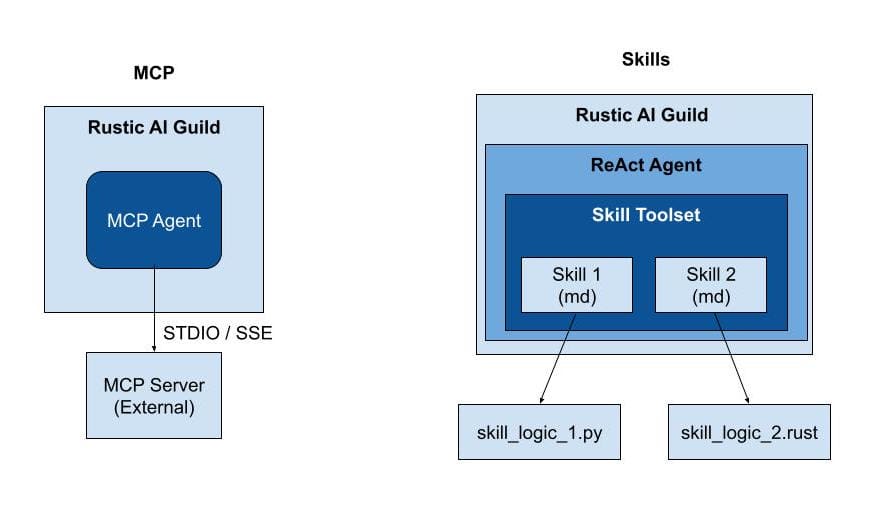
If you’re building agents with Rustic AI, sooner or later you’ll hit this question:
“Should I use MCP… or should I write a Skill?”
At first glance, MCP and Skills can look like two ways to solve the same problem: “How do I make my LLMs actually do things?”
But in practice, they’re very different tools, more like a universal remote versus a custom-built machine. Both are powerful. Both are essential. And choosing the right one can make your agent elegant… or unnecessarily complicated.
The Big Picture (TL;DR)
“MCP is how your agent talks to the outside world while Skills are how your agent learns new tricks of its own”
Or, put another way:
MCP: “Go talk to that tool over there.”
Skills: “Here’s how I know how to do this.”
Key Differences
| Aspect | MCP | Skills |
|---|---|---|
| Scope | External integration | Internal capability packaging |
| Execution | Remote (via protocol) | Local (subprocess) |
| Connection | One agent → One server | One toolset → Multiple Skills |
| Protocol | Standardized MCP | Direct script execution |
| Use Case | Integrate existing tools | Build custom capabilities |
| Distribution | NPM packages, remote servers | Local folders, Git repos |
| Lifecycle | Server process lifecycle | Per-call subprocess |
| State | Server maintains state | Stateless execution |
| Composition | Multiple agents in guild | Multiple Skills in toolset |
The Best Part: You Don’t Have to Choose
The most interesting Rustic AI systems use both.
Picture this workflow:
- User sends a request to scrape a url
- MCP agent searches the website
- MCP agent downloads documents
- Skills analyze, clean, and transform the data
- Another Skill applies business logic
- Agent explains results to the user
That’s not duplication, that’s separation of concerns. MCP handles connections while the Skills handle thinking and doing.
A Powerful Pattern: The Orchestrated MCP Guild
A highly effective pattern that emerges when building with Rustic AI is the orchestrated MCP guild, where multiple MCP agents, each responsible for interacting with a specific external system, are coordinated by a central LLM-powered orchestrator. The orchestrator interprets user intent, tracks previously performed actions, and decides the next best step, delegating work to the appropriate MCP agent. This allows complex, multi-step tasks to be executed from a single user prompt, without requiring the user to manually define workflows or sequences. In a personal workspace guild, for example, this pattern enables surprisingly sophisticated behavior. A single user request like “Organize my notes, schedule follow-ups, and summarize what I missed last week” can trigger a multi-step flow across different MCP agents — one talking to Notion, another to a calendar or task system, without the user needing to specify any steps explicitly.
What makes this pattern especially compelling is its self-healing behavior. When a tool call fails, such as due to incorrect arguments or invalid values, the error is routed back to the orchestrator rather than surfaced directly to the user. The orchestrator reasons about the failure, corrects the input, and retries the action, often resolving the issue transparently. This design shifts agent systems from brittle, one-shot tool calls to adaptive, feedback-driven execution, resulting in workflows that are more robust, resilient, and capable of handling real-world complexity gracefully.
From an architectural perspective, this pattern reinforces the core philosophy behind MCP and Skills in Rustic AI. MCP agents remain focused on doing one thing well: reliably interfacing with external systems. The orchestrator focuses on reasoning, sequencing, and recovery. The result is an agent system that feels less like a script and more like a capable assistant — one that can plan, act, observe, and adjust, all within a clean and maintainable structure.
How Does This Map to Real Teams?
In real teams, this distinction between MCP and Skills maps cleanly onto how organizations already work, which is part of what makes Rustic AI oriented toward production rather than experimentation. Platform or infrastructure teams typically own MCP integrations, treating them as stable connectors to external systems like Notion, GitHub, or browsers, while domain teams focus on building Skills that encode business logic, workflows, and decision-making specific to their area. AI guilds or orchestration layers then compose both to deliver end-to-end outcomes. This separation creates clear ownership, reduces coupling between teams, and allows faster iteration without stepping on each other’s toes. Over time, Skills become more than just tools — they turn into living institutional memory, capturing how the organization actually thinks and works. While MCP gives agents access to the outside world, Skills give them judgment shaped by company context, preserving hard-won tribal knowledge long after individual engineers move on. This combination adds philosophical depth to Rustic AI and makes it especially compelling for engineering leaders, managers, and founders thinking about scale, continuity, and long-term maintainability.
A Practical Rule of Thumb
When you’re stuck deciding, come back to one simple question: “Am I integrating… or am I teaching?” If you’re integrating with something that already exists — a product, a platform, a service — MCP is your answer. If you’re teaching the agent how your organization thinks, decides, and works, that’s a Skill. Getting this distinction right unlocks something bigger than cleaner architecture: it lets your agents grow in the right direction. MCP keeps them connected to the world, while Skills give them depth, judgment, and continuity. Together, they form the foundation of AI systems that don’t just respond, but understand — systems that scale with your tools, your teams, and your institutional knowledge over time.