
40–1: The AI Boom Just Hit the Ballot Box

What America's 2026 elections tell us about the communities expected to power the AI boom—and the new terms they're demanding.
Part 1 of 2. Next: Coming soon...
The story in brief
The AI industry has spent years figuring out how to build bigger data centers, secure more electricity, and deploy more GPUs. On November 3, voters in communities across America reminded it that someone else has a say.
Forty of 41 local ballot measures produced outcomes favoring restrictions on data-center development. Candidates campaigning on the issue won elections, three officials in an Ohio town were recalled, and companies began reconsidering projects and negotiating with incoming governments.
The interesting story isn't simply that people are opposing data centers. It's what they're asking for instead.
Three takeaways
- The backlash isn't one movement with one demand. Some communities want bans. Others want better agreements, enforceable protections, or a meaningful say before decisions are made.
- Data-center development is becoming a political liability. Election outcomes are already changing projects and the relationships between companies and governments.
- The industry needs a better development model. Securing land, capital, and power is necessary. Building lasting agreements with communities is becoming just as important.
The mayor who called it a once-in-a-generation opportunity
In Piqua, Ohio, Mayor James Vetter believed a proposed data center represented the city's best economic-development opportunity in 40 years.
The voters saw things differently.
On November 3, they recalled Vetter and two fellow city commissioners who had supported the development. More than 70% of voters supported the recalls. In a separate vote, residents approved restrictions on data-center construction.
Think about the contrast. The mayor believed he was bringing an extraordinary economic opportunity to his city. Many residents believed their elected representatives were taking the city somewhere it didn't want to go. The disagreement became serious enough to remove three officials from office.
Piqua wasn't an isolated result.
Across ten states, voters decided 41 local data-center-related ballot measures. According to Ballotpedia's November 6 analysis, the score was an extraordinary 40–1 in favor of limiting development or rejecting proposals supporting it.
Twenty-seven restrictive or opposition measures passed. Thirteen proposals supporting development failed. The one exception was Harwood, North Dakota, where voters rejected an additional development-review requirement.
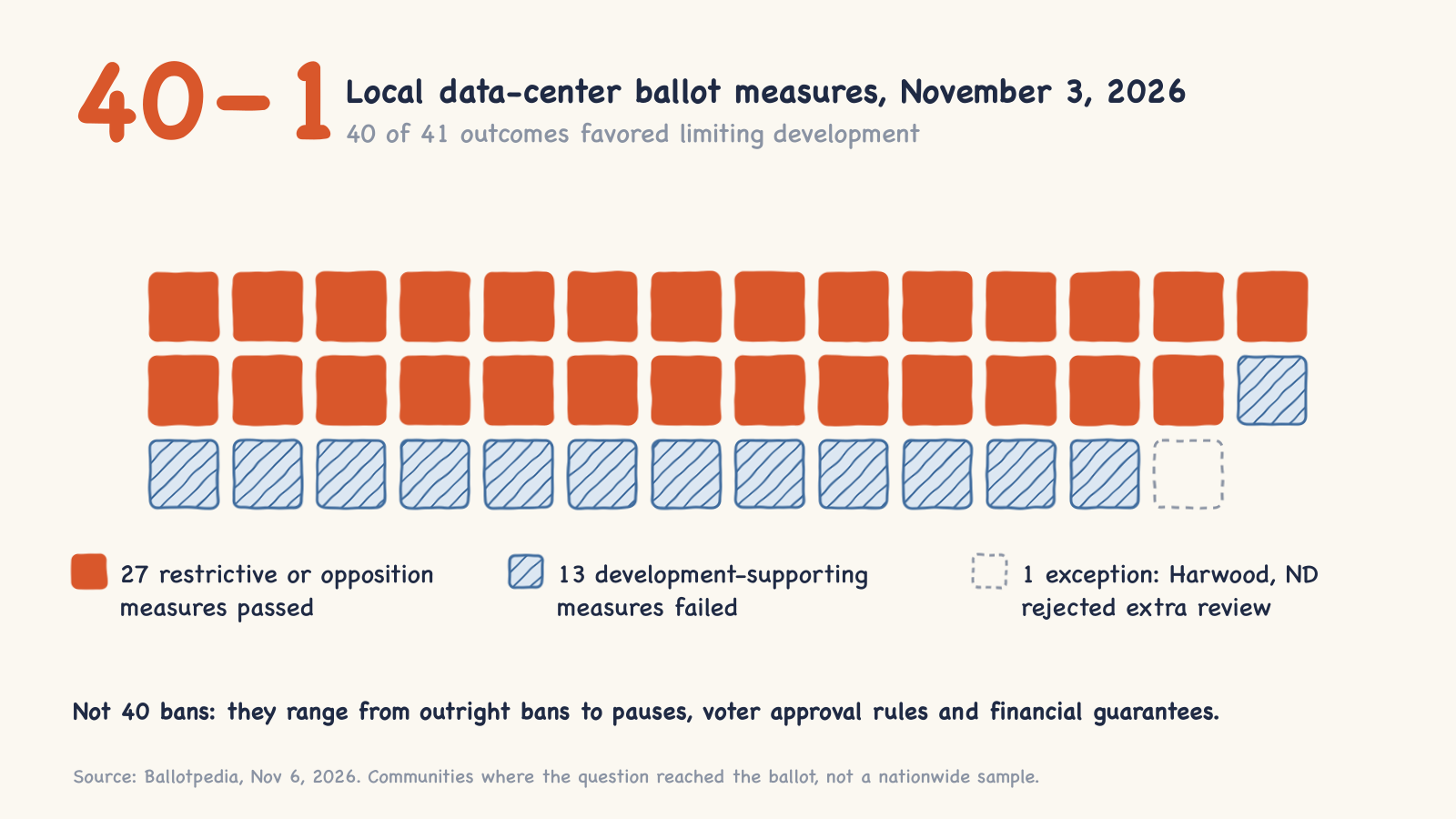
Those numbers are striking, but there's an important detail buried inside them. The 40 favorable outcomes were not 40 outright bans, and they weren't the verdict of a representative sample of American voters. These were communities where the question had already become contentious enough to appear on the ballot.
Look a little closer, though, and something more interesting emerges.
What exactly were people voting against?
Consider two Ohio communities.
In Perry, voters overwhelmingly approved a requirement that hyperscale data-center developers seeking certain tax incentives provide financial guarantees. The message was fairly straightforward: if you're asking the community for financial concessions and promising economic benefits in return, put some financial weight behind those promises.
In Grove City, voters approved a different approach. Major developments crossing specified thresholds for land, electricity, or water would require voter approval, along with enforceable community-impact standards.
Neither decision amounted to a blanket rejection of data centers.
Elsewhere, residents chose outright bans, limits on very large facilities, or temporary moratoriums. Wilmington, Ohio, rejected four rezoning proposals associated with a possible data-center development. Three Maine communities adopted six-month pauses to give themselves time to consider longer-term rules.
These are quite different positions. A community refusing a particular development is not necessarily opposed to all data centers. A community demanding financial guarantees may actually be willing to welcome one, provided the benefits and obligations are real.
And then there's the question of how decisions are made.
In Minnesota, where proposed Google data centers became major local election issues, the reporting is especially revealing.
Mark Lang, a first-time candidate who challenged the handling of a proposed development in Pine Island, won the mayoral election with roughly two-thirds of the vote. In Hermantown, two newcomers who campaigned against another proposed Google development won council seats.
Yet the outcome wasn't universal. In Monticello, an incumbent mayor survived a challenge from a data-center opponent by just 40 votes.
Reporting by Minnesota Public Radio captured something that could easily get lost in a national story about an anti-data-center backlash: some residents weren't entirely sure whether they opposed the facilities themselves. What angered them was the secrecy, including nondisclosure agreements and decisions they believed had been made before the public had a meaningful chance to participate.
I find that distinction important.
If someone is worried about the electricity grid, you can investigate grid capacity and determine what upgrades are necessary. If they're worried about water, you can examine the cooling technology and local water supply. If they're unhappy about tax incentives, you can put the economic terms on the table.
But what do you do when people believe the whole process was designed to keep them out?
By then, the disagreement has become about trust. And trust is considerably harder to engineer than a cooling system.
There's a temptation to divide everyone into two camps: people who understand AI's importance and people standing in the way of progress. The election results don't support that tidy division.
Some communities want the development stopped. Some want more time. Others want a fairer deal.
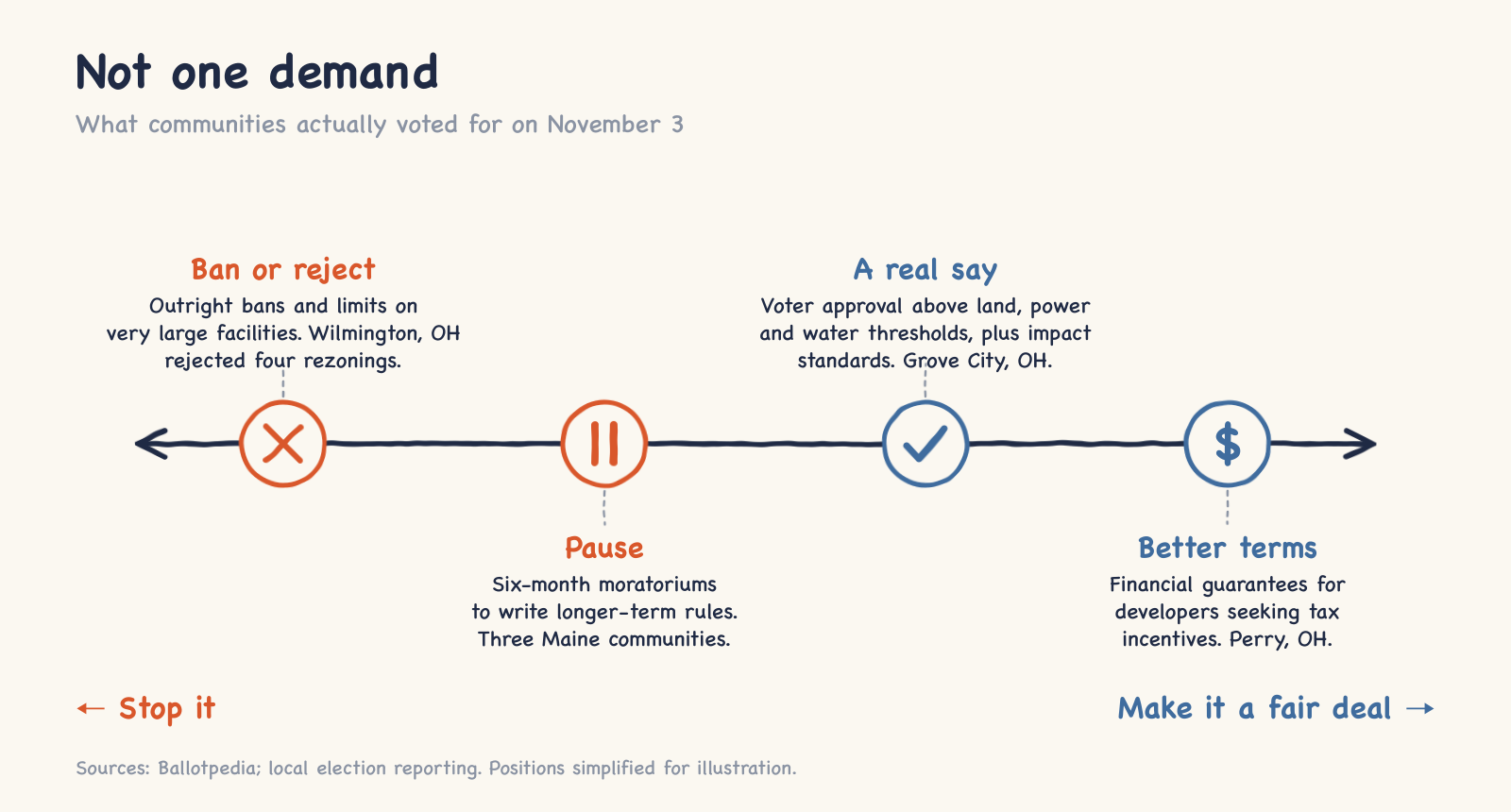
A serious industry response has to start by recognizing those differences.
Is a data center actually a good deal for a community?
When a company announces a $2 billion data-center investment, it sounds like an extraordinary economic opportunity. And it may well be.
But I'd want to understand what that number actually means for the people living nearby.
How much will the local government collect in taxes? Are there tax abatements? Who pays to improve the roads, electricity grid, and water infrastructure? How many permanent jobs will exist when construction is finished?
The answers vary enormously.
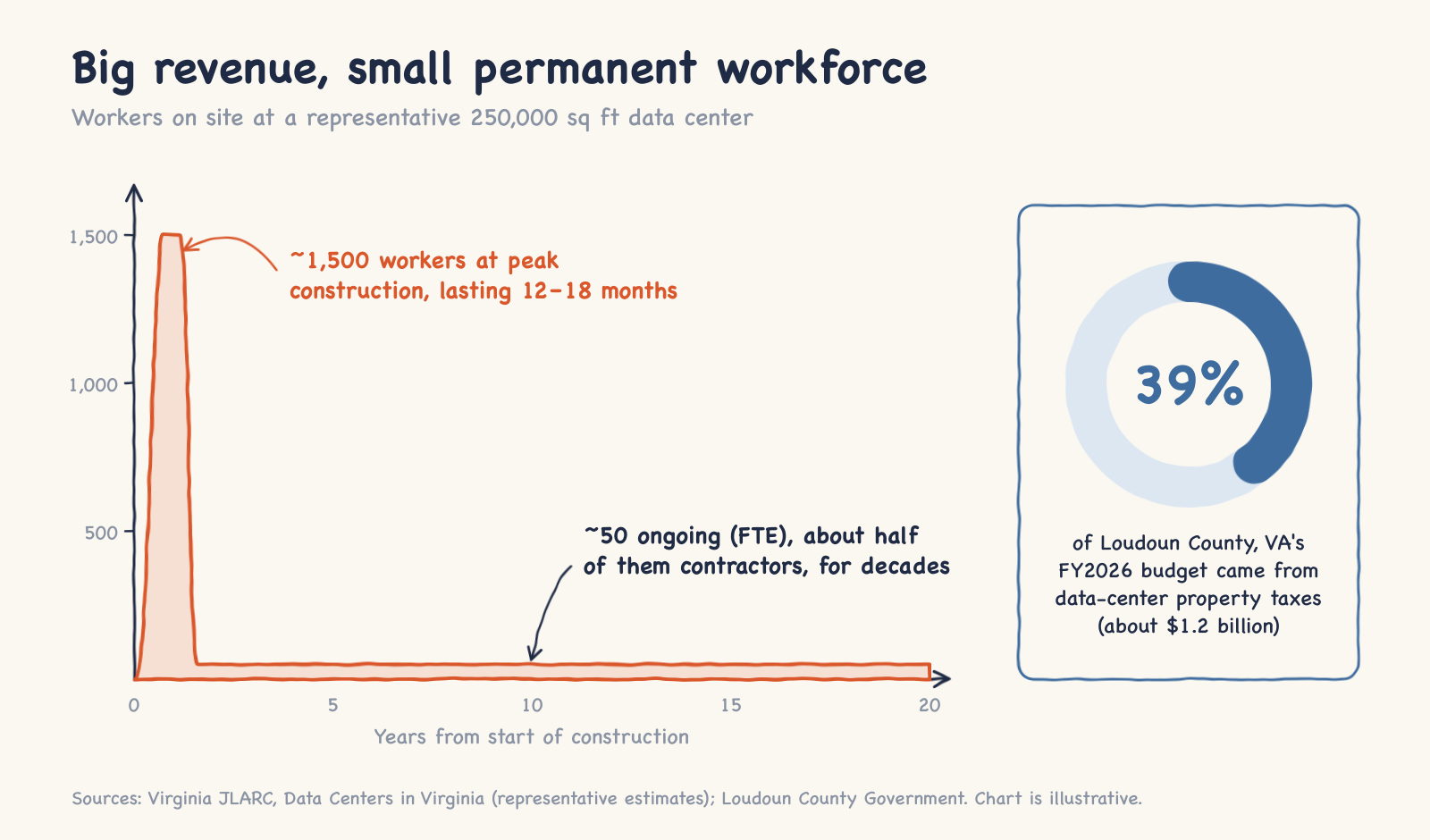
Take Loudoun County, Virginia, home to one of the world's largest concentrations of data centers. According to the county government, data centers generated approximately $1.2 billion in real and personal property taxes in fiscal year 2026, representing 39% of its budget. That's substantial public revenue, and it helps explain why local governments may actively seek these developments.
Now consider Georgia. A state tax-incentive evaluation estimated that its data-center sales and use tax exemption cost about $474 million in forgone state revenue in fiscal year 2025. That's state revenue, not money taken from county budgets, and the same evaluation also attributed substantial economic benefits to the incentive, including construction activity and operational jobs. The exemption doesn't make the investment a bad deal, but it is part of the cost of attracting it.
These examples aren't directly comparable. They're different jurisdictions, with different tax systems. But that's precisely the point. The headline investment figure tells us very little about the actual financial deal.
Then there are the jobs.
Virginia's legislative auditors found that a representative 250,000-square-foot data center may employ about 50 people on an ongoing full-time-equivalent basis, roughly half of them contractors. During peak construction, the same building might have around 1,500 workers on site.
That's meaningful construction activity, but it's a peak workforce rather than 1,500 permanent jobs, and construction of a building generally lasts 12–18 months. The permanent workforce is much smaller.
And the resource commitments last considerably longer.
A large facility may require new electrical infrastructure, water supply capacity, roads, and emergency services. If the development doesn't consume as much electricity as projected, or leaves before the infrastructure costs have been recovered, who pays for the remaining investment?
These aren't hypothetical questions. Utility regulators are already designing special tariffs and financial guarantees to protect existing customers against precisely those risks. The Federal Energy Regulatory Commission explains how grid-upgrade costs flow through utilities to customers, and in June it ordered all six regional grid operators to justify or revise their rules for connecting large electricity users such as data centers, with consumer protection a central concern.
Water presents a similar problem. A Congressional Research Service report, citing the IEA, illustrates that a 100-megawatt data center may directly consume about as much water each day as 2,600 households. That figure excludes the water used to generate its electricity, and actual requirements vary significantly with cooling design, climate, and operations. Some designs save water at the expense of additional electricity.
So the economic calculation isn't simply investment versus opposition.
A data center can be a valuable source of public revenue, a relatively modest source of permanent employment, and a major consumer of local infrastructure—all at the same time.
That helps explain why Perry, Ohio, voted overwhelmingly for financial guarantees rather than an outright ban.
Residents weren't necessarily saying the investment had no value. They wanted the promised value to be backed by enforceable commitments.
And I think that's a question any community should be able to ask: What will this development actually contribute over the next twenty years, what will it cost us, and who carries the risk if the projections turn out to be wrong?
From local complaints to political commitments
The issue also moved well beyond town halls and zoning boards.
Data Center Watch examined the public positions of 393 declared congressional winners and 34 gubernatorial winners in a November 5 analysis.
Of those congressional winners, 61 supported some form of ban or moratorium, including 57 House members and four senators. Another 246 supported regulation or conditional development. Among the governors-elect in its sample, 12 supported bans or moratoriums and 20 supported regulation or development subject to conditions.
Those figures need to be read carefully. Supporting regulation doesn't mean opposing development. Nor can we infer that data-center positions caused those candidates to win. The results came from elections involving much broader questions, and the classifications are based on positions documented by one research organization.
Still, the shift is significant. Data-center policy is no longer confined to a handful of planning disputes. It has become an issue on which candidates are making commitments that voters and communities may expect them to keep.
In Texas, Governor-elect Gina Hinojosa campaigned for a development moratorium until stronger protections could be established. Georgia's incoming governor, Keisha Lance Bottoms, also called for a pause. In several other races, competing candidates disagreed less about whether additional conditions were necessary than about what those conditions should be.
For an industry accustomed to planning infrastructure years in advance, this introduces a complication.
A project might be negotiated under one administration, permitted under another, and completed under a third. If each change in leadership brings a new interpretation of the development agreement, financing and construction become more complicated.
But the opposite is also possible. Clear rules, transparent obligations, and a credible approval process could give developers greater certainty than fragile agreements negotiated behind closed doors.
That may be one of the more useful lessons of the election: political oversight doesn't necessarily make development impossible. Uncertainty about the rules—and whether the community accepts them—makes it difficult.
The consequences have already reached building sites
The most compelling evidence that this matters is what happened immediately after the election.
In Oregon, Ohio, voters passed a charter amendment restricting data centers exceeding 25 megawatts. On November 5, Vantage Data Centers said that its proposed project would no longer proceed in its existing form.
That's a real development consequence, not a theoretical risk to a future investment.
In Ashville, Ohio, voters rejected a preliminary development framework involving EdgeConneX and a proposed facility with associated power generation. The result doesn't automatically prohibit every alternative project, but it does remove the existing agreement framework.
Then there's CoreWeave in Texas.
On November 7, Bloomberg reported that CoreWeave CEO Michael Intrator had written to Governor-elect Hinojosa seeking cooperation on existing and future developments. The company emphasized responsible completion of permitted projects and predictable standards for future expansion.
I find that more interesting than the immediate stock-market reaction.
Here's a company building the computing infrastructure that AI companies depend on, approaching an incoming governor who campaigned on a more restrictive policy. Both sides have something important at stake.
CoreWeave wants its approved investments protected and a workable route for future projects. The incoming administration has promised a different relationship between the data-center industry and Texas communities. Neither side necessarily benefits from years of unresolved uncertainty.
So what would a workable agreement look like? How should already-permitted projects be treated? Who pays for upgrades to the grid? What obligations apply to new facilities, and what would allow a moratorium to end?
Those are no longer abstract policy questions. They're business negotiations with potentially enormous consequences.
OpenAI made another notable announcement on November 5, publishing a new community compact and infrastructure policy blueprint. The commitments include paying the full costs of electricity and infrastructure for campuses it owns and operates, offering financial assurances, reporting on local impacts, and engaging residents earlier in the development process.
The company had begun work on community commitments before the election, so it would be misleading to present the announcement as a response caused entirely by November 3. But it is evidence that community relationships have become an explicit part of the industry's infrastructure strategy.
And that seems overdue.
When a project requires large amounts of power, land, capital, and public infrastructure over many years, it can't be treated like an ordinary commercial installation. Its effects extend far beyond the walls of the facility.
The communities hosting it deserve more than a presentation about its economic benefits. They deserve an opportunity to examine the costs, negotiate the terms, and hold the developer accountable.
The benefits are real, too. Construction activity, tax revenue, infrastructure improvements, and new business opportunities can matter enormously to a community. Vetter's argument in Piqua shouldn't be dismissed simply because he lost his office.
But the benefits have to be evaluated alongside the costs. A promise of economic growth means less if the jobs, revenue, and infrastructure commitments are vague or unenforceable.
A more durable way to build
I don't read the election as evidence that America is about to stop building data centers. Demand for computing isn't disappearing, and many communities will continue to see opportunities in hosting the infrastructure.
What has changed is the willingness of some communities to accept the industry's preferred terms.
That distinction matters because the solutions are different.
If the problem were simply opposition to AI, the response might be better public education about the benefits of the technology. But the voting patterns suggest that many of the disagreements concern the practical terms of development: financial responsibility, resource use, transparency, and local authority.
These are things developers and policymakers can actually address.
A workable framework might include early public consultation, transparent utility-cost allocation, enforceable commitments, environmental review appropriate to the location, and clear criteria for approving or declining projects. Moratoriums need defined purposes and a route to resolution. Communities need ways to hold developers accountable, and developers need confidence that compliant projects won't face an endless series of changing requirements.
None of that guarantees agreement. There will be places where communities decide that a particular facility simply doesn't belong.
But it creates a better starting point than assuming that sufficient investment entitles a project to proceed.
The AI industry has become remarkably good at announcing capacity: another multibillion-dollar campus, another gigawatt, another collection of GPUs. We're less accustomed to asking what happens between the announcement and the moment that infrastructure actually begins delivering value.
The 2026 elections have made that gap harder to ignore.
And they leave us with a question that reaches beyond politics.
If new computing infrastructure is becoming harder to approve, finance, and deliver, what happens to the companies whose plans depend on all that future capacity arriving on time?
That's where the story gets even more interesting.
That's the subject of Part 2!
Research note: This article reflects reporting available through November 9, 2026. The 40–1 figure refers to Ballotpedia's November 3 local ballot-measure sample, not a nationwide voter survey. Candidate counts are attributed to Data Center Watch's preliminary classification. Election outcomes remain subject to canvassing and certification, and candidate positions do not establish why individual elections were won.
Principal sources: Ballotpedia's election analysis, Data Center Watch, Piqua election reporting, MPR News, Vantage's response, Bloomberg's CoreWeave report, OpenAI's community compact, Loudoun County, Georgia's tax-incentive evaluation, Virginia JLARC, Congressional Research Service, and FERC.