When AI Can't Just Build More

The data-center backlash could change the economics of neoclouds, strengthen some incumbents, and force us to rethink how much computing intelligence really needs.
Part 2 of 2. Previously: 40–1: The AI Boom Just Hit the Ballot Box
The analysis in brief
The political resistance to new data centers arrives at an awkward moment for an industry betting extraordinary sums on future computing capacity.
For developers, cloud providers, and AI model companies, the important distinction is increasingly between infrastructure they've announced and infrastructure they can actually deliver. Constraints on new construction could make existing computing capacity more valuable while exposing companies financing large expansion programs to greater risk.
There's a less obvious consequence, too. When computing infrastructure becomes harder to expand, using it more intelligently starts to matter much more.
Three takeaways
- Existing capacity and future capacity are becoming very different assets. Secured power, completed construction, and working systems may matter more than ambitious development pipelines.
- Compute scarcity won't affect AI companies equally. Neoclouds face both opportunities and financing risks. Hyperscalers have advantages, but their own expansion commitments remain substantial. Frontier model companies depend increasingly on infrastructure execution.
- The next competitive advantage may be computing productivity. Better utilization, specialized models, reusable knowledge, and selective reasoning can help deliver more useful work without proportionally increasing infrastructure.
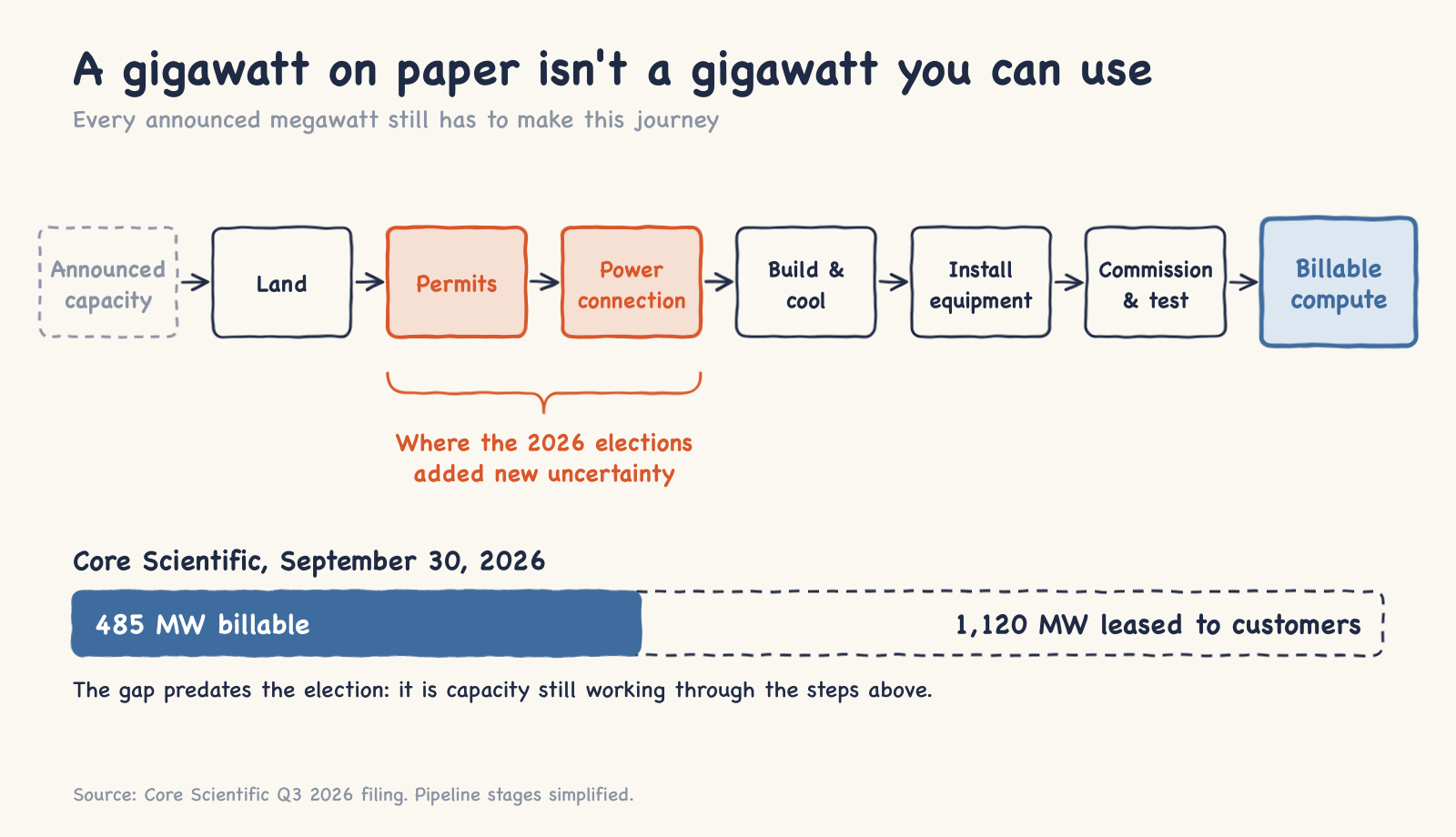
A gigawatt on paper isn't a gigawatt you can use
There's an interesting number in Core Scientific's latest quarterly filing.
As of September 30, the company reported 1,120 megawatts of leased customer power capacity. Of that, 485 megawatts was billable.
Those are two very different numbers.
The remaining contracted capacity represents future business that still requires work before it reaches the same commercial stage. Some facilities need further construction, equipment, commissioning, or other steps before the full associated revenue becomes billable.
To be clear, this gap existed before the election. It is not evidence that voters caused a Core Scientific project to fall behind.
But it illustrates something I've been thinking about since the election results came in.
We talk about AI infrastructure almost entirely in terms of announced gigawatts. Companies announce them, investors value them, and model developers plan around them. A large future capacity number becomes evidence of how much the company will grow.
Yet there's a considerable distance between announcing a gigawatt and turning it into computing that someone can use.
The site needs land, permits, power, cooling, buildings, networking, and equipment. Then someone has to install the systems, commission them, and make sure the workloads actually run.
We've become very good at describing the destination. Perhaps we haven't paid enough attention to the journey.
In Part 1, we examined how the 2026 elections exposed a new level of political resistance to data-center development. Forty of 41 local ballot measures favored restrictions or rejected development-supporting proposals.
The significance for the AI industry isn't that all those future gigawatts will now disappear. Many won't be affected, and much depends on how policies are written and implemented.
It's that another source of uncertainty has become harder to ignore.
An existing facility with secured power, operational equipment, and paying customers is not the same asset as a proposed campus that still needs approval, construction, and commissioning.
When those remaining steps become more expensive or less predictable, the difference matters.
A lot.
The neocloud dilemma: Good news and bad news at the same time
Neoclouds sit in a particularly interesting position.
Companies such as CoreWeave, Nebius, and Lambda have built businesses around supplying specialized AI computing capacity. Their proposition is compelling: provide the hardware, systems, and operational expertise that customers need without requiring every AI company to build its own infrastructure.
Demand for that capability has been enormous.
CoreWeave, for example, reported operating 51 data centers with more than 1.5 gigawatts of active power as of June 30. It also reported approximately 4.2 gigawatts of contracted power at its August earnings call. The company is expanding internationally, not simply betting on development in one US state.
Those figures tell us two things. CoreWeave has a substantial operating business, and it also has an ambitious pipeline of future capacity.
Now consider what happens if building that future capacity becomes harder.
The obvious conclusion is that scarcity should be good for a company selling compute. If customers need GPUs and fewer new facilities are coming online, operating capacity ought to become more valuable.
That can certainly happen.
But suppose a neocloud has contracted to deliver a new cluster at a future date. The equipment has been ordered, the facility is being financed, and the customer is making plans around its availability.
Then the electrical connection is delayed by six months.
The facility may not yet be generating the revenue originally expected. Financing obligations may continue, depending on the agreements. Equipment purchases and construction commitments may already have consumed substantial cash. Customer contracts may contain delivery milestones, remedies, or termination provisions.
And the hardware has a problem that land does not: it ages technologically even when it isn't being used. A six-month delay consumes part of the period during which a particular generation of accelerators can command attractive economics.
The details depend on the contracts. Some financing arrangements protect borrowers from delays. Some customer agreements have flexibility. Equipment orders may be rescheduled. We shouldn't assume every operator experiences every cost.
But the basic tension remains.
The provider might be benefiting from strong demand for its existing computing capacity while facing significant problems completing its next facility.
There's another twist. Even if market prices rise, the operator might not benefit as much as expected. Some capacity is sold under long-term agreements with pricing and terms negotiated earlier. Depending on the contracts, the customer, landlord, lender, or power supplier may capture part of the value created by scarcity.
This is why I wouldn't describe the election as simply bad for neoclouds.
It could be good for the capacity they already operate and bad for the capacity they still need to build.
The financing environment makes that distinction even more important.
On November 9, Reuters reported that lenders and investors were becoming more cautious about AI-related debt. They were paying closer attention to cash flows, construction deadlines, customer guarantees, and contractual commitments.
That caution wasn't caused exclusively by the election. Broader market volatility and concerns about infrastructure investment were already present. But new permitting uncertainty doesn't make the financing problem easier.
I suspect the next phase will distinguish companies less by the size of their announced development pipelines and more by the quality of their contracts, financial resilience, and ability to deliver on schedule.
Some may benefit enormously from scarce operational capacity. Others may have to slow expansion, renegotiate commitments, or find stronger partners. Consolidation is possible, although it is far too early to declare it inevitable.
For AI customers, this creates a practical lesson: a cloud provider's future capacity announcement isn't a substitute for understanding when that capacity becomes available and what happens if it doesn't.
Does this hand Big Tech an even bigger advantage?
Here's the most uncomfortable possibility.
Communities are pushing back against the enormous physical footprint of AI infrastructure. But making new facilities harder to build could increase the value of facilities already owned or controlled by the largest technology companies.
That could strengthen the very concentration of infrastructure that worries many people.
Consider the advantages enjoyed by established hyperscalers.
They operate large fleets of data centers. They have engineering teams experienced in power, cooling, networking, and construction. They maintain relationships with utilities and hardware suppliers. Their financing options are generally broader than those of smaller developers.
They also have more flexibility in deciding where and how workloads run.
If a particular project faces a delay, a large provider may be able to redirect investment, move suitable workloads elsewhere, or change its infrastructure plans. Those options aren't free, and some workloads are difficult to relocate. But having alternatives matters.
For a company whose business depends on a single future campus, the same delay can be existential.
However, it would be a mistake to conclude that Big Tech is immune.
Microsoft's 2026 annual report, for example, disclosed approximately $329 billion in additional leases—primarily for data centers—that had not yet commenced, with start dates spanning several future years.
That's an extraordinary commitment to infrastructure still coming online. It represents multiyear lease arrangements, not a single year's spending, but it illustrates the exposure even the largest companies carry.
Amazon has its own enormous infrastructure commitments, including agreements to supply compute for Anthropic. These relationships create opportunities, but they also require physical delivery.
Google presents an especially interesting case.
Unlike companies relying primarily on externally supplied accelerators, Google has spent years designing its own TPUs. It uses them for Gemini, offers them through Google Cloud, supplies compute to other AI companies, and now supports customers deploying TPU systems in their own data centers.
On November 9, Google announced two additional eighth-generation TPU configurations, extending a portfolio optimized for training, inference, long-context workloads, and confidential computing.
That's a different kind of flexibility.
Google can make coordinated decisions across models, hardware, software, networking, and infrastructure. It can sell computing services to other AI developers while competing with them through Gemini.
The business becomes interesting even when a customer chooses another model.
If that model runs on Google's infrastructure, Google may still participate in the economics.
I wouldn't assume this guarantees superior returns. Designing custom hardware brings its own costs, risks, and technology dependencies. Google also has to build physical facilities, and its new projects face the same communities and regulatory processes as everyone else's.
But vertical integration and deployment flexibility may become more valuable when new infrastructure is difficult to deliver.
This is the paradox worth watching: constraints on new capacity could make the AI market more concentrated, even when the intention behind those constraints is greater public accountability.
Better regulation and fair competition should not have to be mutually exclusive. Clearer, consistent requirements could give responsible new entrants a path forward instead of leaving the market to companies that already possess the most infrastructure.
OpenAI and Anthropic aren't just building models anymore
There's another side to this story that I think gets too little attention.
We tend to judge frontier AI companies through their models. Who has the strongest reasoning system? Who is best at coding? Who delivers the lowest latency or highest benchmark score?
Those are still important questions.
But look at the infrastructure strategies behind OpenAI and Anthropic.
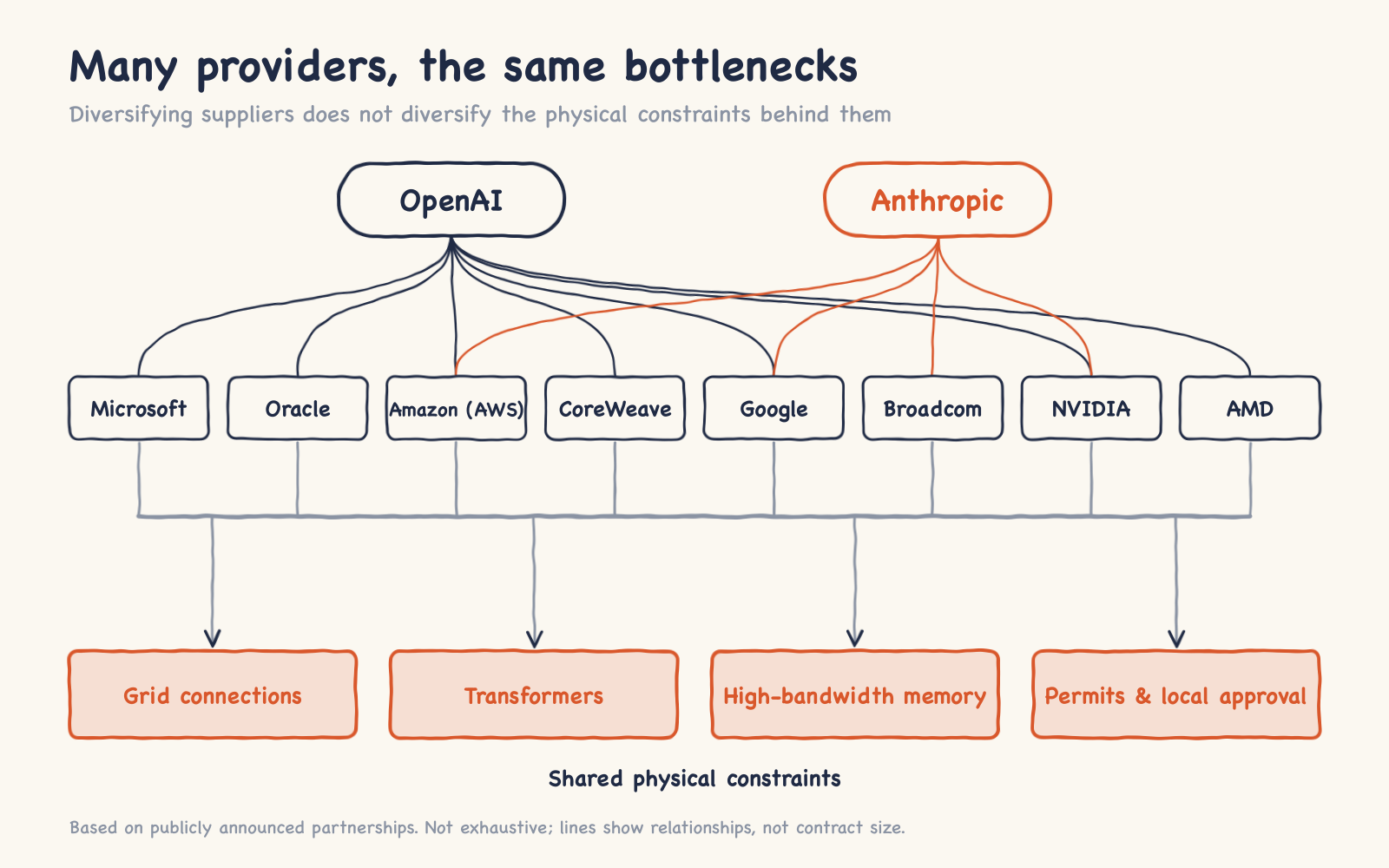
OpenAI has assembled relationships spanning Microsoft, Oracle, AWS, CoreWeave, and Google Cloud, alongside NVIDIA, AMD, Cerebras, and custom silicon efforts.
Anthropic has announced major capacity commitments with Amazon, Google, and Broadcom, and uses a mix of Trainium, TPUs, and NVIDIA GPUs. Its Google–Broadcom expansion includes multiple gigawatts of next-generation compute expected to begin coming online in 2027.
These are not ordinary software procurement contracts.
They're long-term efforts to secure the physical capacity on which the companies' future models, products, and customer commitments depend.
The scale introduces some interesting tradeoffs.
Diversifying providers can reduce reliance on any one vendor. That's a sensible strategy. But five providers don't necessarily mean five independent sources of capacity. They may rely on overlapping electrical infrastructure, chip supply chains, geographic regions, or construction resources.
If several partners need the same scarce transformers or high-bandwidth memory, a portfolio of contracts does not automatically eliminate the underlying constraint.
Then consider the operational side.
A frontier model company has to decide how much capacity to allocate to training, experimentation, fine-tuning, inference, and customer workloads. Those decisions become more consequential when capacity is scarce or expensive.
A new model could deliver significantly better capabilities but require much more inference compute. Is that always a commercially attractive improvement?
What happens when a large enterprise customer needs additional serving capacity in a particular region? What if existing customers increase their usage faster than expected?
Model quality matters, but so does the ability to deliver that quality reliably and economically.
I don't think the election results establish that OpenAI or Anthropic will have to delay model launches or increase prices. We don't have evidence for those conclusions yet.
They do reinforce something that was already becoming clear: infrastructure execution is part of the AI product strategy.
A breakthrough in model capability has limited commercial value if the company cannot supply it at an acceptable cost, latency, and level of availability.
The reverse is also true. Securing enormous amounts of capacity doesn't guarantee the models or products will create enough value to justify it.
The challenge is getting both sides right.
What if we stopped treating more compute as the answer to every problem?
There's a broader question I've been thinking about as we build AI systems.
We've made tremendous progress by scaling models and the infrastructure supporting them. I don't expect that approach to disappear. Frontier computing will remain essential for difficult research, complex reasoning, multimodal workloads, and many other applications.
But we've also developed a habit of reaching for a large general-purpose model whenever we encounter a problem involving language or intelligence.
Sometimes that's exactly the right tool.
Sometimes it seems remarkably wasteful.
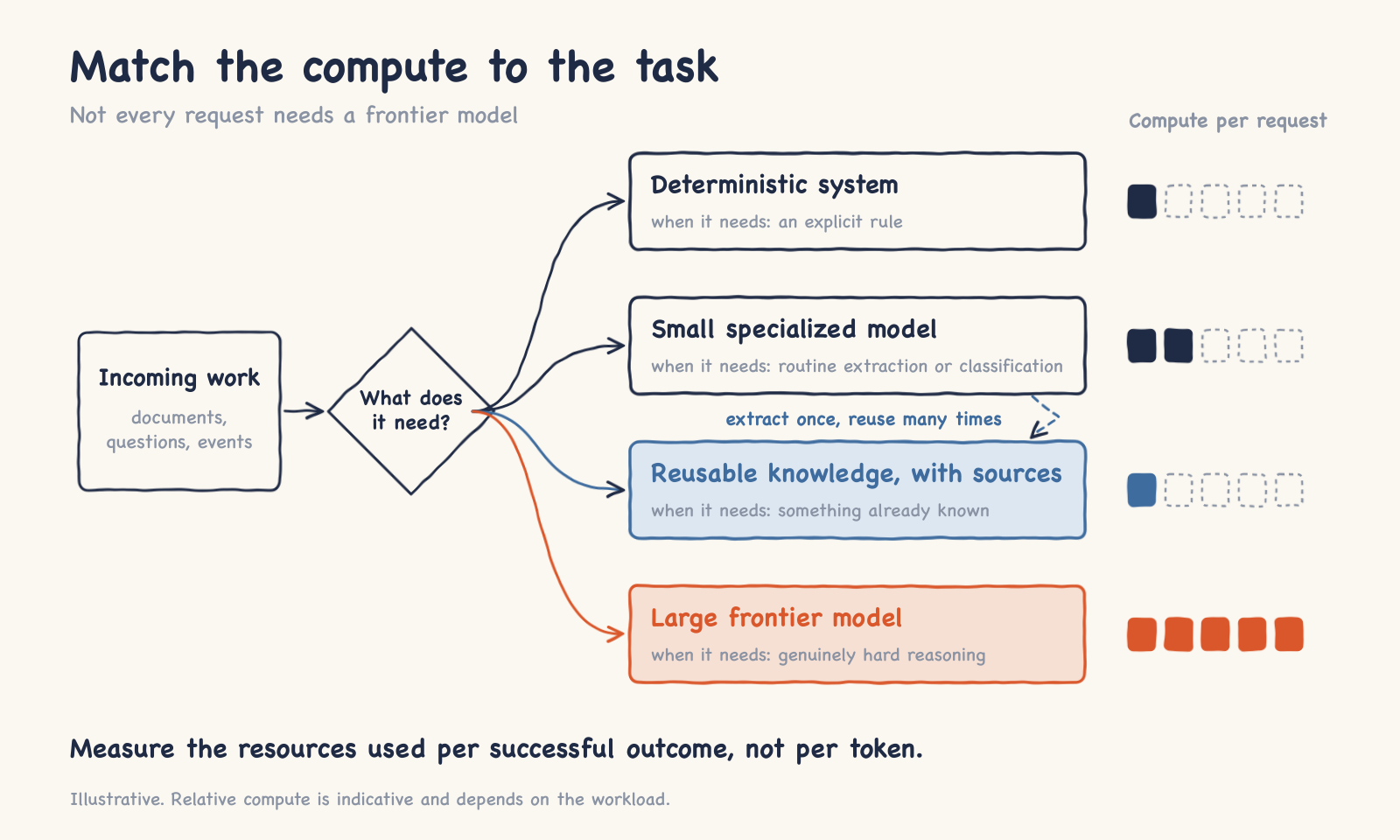
Take a fairly ordinary enterprise workflow. A company receives service records, contracts, equipment manuals, and customer communications. Its AI system needs to understand who owns what, which equipment is installed where, what obligations exist, and which events changed those relationships.
One approach is to repeatedly feed documents and relevant context to a large model whenever someone asks a question.
That can work. For a small volume of requests, it may even be the simplest and most economical solution.
But what happens when the same information is used thousands of times?
We might extract the relevant knowledge once, preserve its sources and context, update it when new information arrives, and make it available for subsequent queries and reasoning.
We could use specialized models for routine extraction and classification, deterministic systems for explicit rules, and a larger reasoning model when the task genuinely warrants it.
Of course, maintaining structured knowledge creates costs of its own. Information changes. Extraction can be wrong. Provenance, validation, and updates need to be handled carefully. A poorly designed knowledge system can be less reliable and more expensive than simply using a frontier model.
That's why the comparison needs to be made across the entire workflow.
But the design space is much larger than choosing which LLM receives every request.
And this is where I think AI efficiency becomes especially interesting.
The industry talks a great deal about tokens per second, inference cost per token, accelerator utilization, power usage effectiveness, and energy-efficient data centers.
All useful measurements.
But the result we actually care about is successful work.
How many resources did we consume to make a correct decision, extract reliable knowledge, answer a customer's question, or complete a business process?
If one architecture uses fewer tokens but requires repeated retries, it may not be more efficient. If another uses a smaller model but produces more errors, the apparent savings may disappear when those errors have to be fixed.
A useful comparison must include quality, latency, maintenance, and total resource consumption.
The International Energy Agency's 2026 outlook projects data-center electricity consumption nearly doubling, from approximately 485 terawatt-hours in 2025 to 950 in 2030. It also describes constraints involving electricity infrastructure, advanced chips, and high-bandwidth memory.
Making chips and models more efficient will help. But efficiency alone doesn't necessarily reduce total energy consumption. When a technology becomes cheaper, we often use much more of it.
That's why I'm increasingly interested in how much computation a system actually needs to accomplish useful work, rather than how cheaply it can execute any particular operation.
There is a sustainability benefit here, and an economic one. There can also be an independence benefit. Systems that run essential functions on widely available hardware or across different providers give their owners more deployment choices.
None of this requires abandoning the cloud or training every model yourself.
It requires being more deliberate about which capabilities depend on external infrastructure and which don't need to.
We need both kinds of progress
The 2026 elections will not end the data-center boom. The demand for computing is too substantial, and the opportunities created by AI are too important to assume that development simply stops.
Nor should it.
We need new infrastructure, better energy systems, more capable hardware, and communities willing to host the facilities that make increasingly powerful AI possible.
But the economics of the next phase may look different from those of the last few years.
A proposed gigawatt will need to be judged by its likelihood of becoming operational capacity. Neoclouds will have to balance the value of scarce computing with the financial obligations of building more. Hyperscalers will need to use their infrastructure flexibility without allowing expansion commitments to outrun demand.
And companies building AI products will have to think harder about what each unit of compute actually delivers.
For those of us building AI systems, that last question is particularly important.
We've spent years watching the industry demonstrate what becomes possible when we make models larger and give them more computing power.
I'd like to see us put just as much ingenuity into the other direction: making intelligence more capable, more reusable, and more practical with the resources already available.
The future of AI will still require more computing infrastructure. But it shouldn't depend on building a proportionally larger data center every time we want to do something more intelligent.
That seems like a worthwhile engineering challenge.
And, increasingly, a business necessity.
Analysis note: Reporting reviewed through November 9, 2026. Capacity figures are stated as of their respective disclosure dates. The examples of possible financial impacts from construction delays are illustrative; actual exposure depends on company contracts and financing arrangements. Market-concentration and architectural conclusions are analysis, not confirmed consequences of the election.
Principal sources: Core Scientific Q3 2026 filing, CoreWeave infrastructure expansion, Microsoft 2026 annual report, Google's new TPU systems, OpenAI infrastructure strategy, Anthropic–Google–Broadcom partnership, Reuters on AI infrastructure financing, and IEA's Energy and AI outlook.